Author Archives: Kent Sterling
Indianapolis Colts – Julio’s contract a bad fit! Pacers likely keep Bjorkgren! IU’s Woodson best hire of year!
Indy 500 Blackout silly! Colts CB Marvell Tell no regrets! Indiana Pacers pres Pritchard preaches patience!
Indy 500 Blackout – it’s continued existence is nonsensical, especially as COVID restrictions are in place

The Indy 500 live and local blackout is illogical and bad business. Why it continues is a mystery. That it would return during COVID restrictions would be shameful.
Every year, the same debate rages in central Indiana – should the Indy 500 live and local TV blackout be permanently lifted?
Twice in recent memory the Greatest Spectacle in Racing has been available for television viewers in the city where the race is run. Last year, when no one was allowed on the grounds of the Indianapolis Motor Speedway and in 2016 when the race was sold out, Indy residents could watch the race live. Other years, the only mass media allowed to broadcast the race was via the IMS Radio Network.
Of course, live local TV blackouts of sporting events are idiotic. That’s why they no longer exist, with the exception of the Indy 500. Blackouts depress the gate instead of enhance it. NBC’s broadcast of the Indy 500 is a love letter to the event, and will pique the interest of young Hoosiers, making it more likely they would attend future races. Instead, people in power have embraced the arcane notion a blackout forces fans who want to see the race to buy tickets.
The NFL and NHL used to believe it too. Then they figured out what was already obvious. TV is an extended commercial for attending the events it broadcasts. People watch and say to each other, “That looks like a fun way to spend a few hours! I want to got there! Let’s buy tickets!” That is why all similar blackouts went bye-bye a generation ago. But for some reason, this one lingers as a ridiculous ode to bad business practice.
For younger viewers, their understanding of the blackout is more stark and troubling. If an event is not broadcast live, it doesn’t exist. There are not more likely to buy tickets – they refuse to be believe the race happens. Instead of perceiving the Indy as a cool event and fun way to spend the day before Memorial Day, they choose another option.
The decision as to whether the Indianapolis Motor Speedway will lift the live blackout has yet to be made, despite the race being only six days away. It would be easy to argue that a COVID driven attendance cap of 135,000 should make this the simplest of all calls. Because the 135K tickets are gone the race is technically a sellout, so who would gain from blocking Indy residents from watching the race live. That lost-in-the-weeds argument is unnecessary because the blackout defies logic as a concept.
IMS president Doug Boles told WISH-TV yesterday that the blackout had not yet been discussed, and that a decision would be made this week. Knowing how detail-oriented Boles and Penske are, I don’t believe that for a minute. The longer they kick the can down the road, the more heroic their gesture of access – and the most money the radio network can bill for its spots.
Again, no one benefits from continuing the blackout. No one. With live TV, national ratings will be bigger, more tickets will be sold, and the coolness of the Indy 500 will be shared with a generation of Hoosiers who otherwise would never know it exists. Yes, the radio network potentially loses a fairly intense lift from the Indy market’s 10 rating and 60 share, but what does that mean to IMS owner Roger Penske in the grand scheme of things?
The longstanding traditions fo the Indianapolis 500 can be quaint to the point of confusion, but Penske is one of the world’s clearest thinkers. I assumed when he bought the Speedway and all its assets, he would redline the blackout on day one. Not so far. We can only hope logic wins on a year by year basis prior to the last live and local TV blackout in American sports media being deemed obsolete.
Colts last work week! Pacers presser today! Dixon on Indy 500 pole! Lefty oldest winner ever! Cubs win in STL!
Indiana Pacers – Does Nate Bjorkgren deserve another shot? Is Malcolm Brogdon too worldly & wise? Time to re-plate?
Colts Ya-Sin among biggest question marks! Pacers blown out; Bjorkgren timeout begging odd! #iubb fans happy, so let us enjoy May! Troughs stay at IMS
Indiana Basketball – 5 reasons for big optimism after Mike Woodson’s 1st 7 weeks! Colts o-line bond! Pacers may crash party tonight!
Colts offensive line is filled with five big bodies, 10 quick feet, and one beautiful and selfless spirit
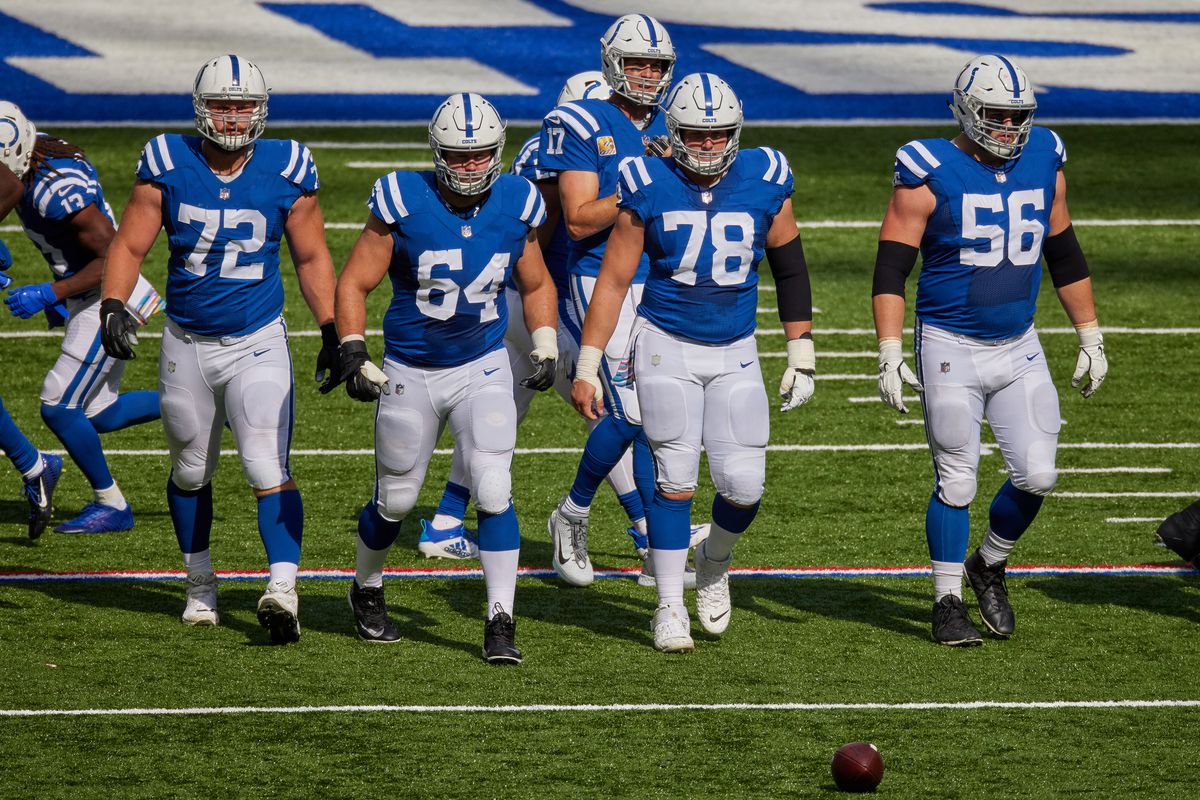
The Colts offensive line a five-man collective that wins succeeds of fails as a group to give the team a chance to win.
“Whatever the team needs,” is a refrain often heard from members of the Indianapolis Colts offensive line when they speak to the media. When they are asked by the media to indulge in a little egomaniacal self-praise, they defer with a disdainful smirk.
Quenton Nelson was asked Monday to comment on his potential legacy as the best left guard to play in the NFL, and he was clearly annoyed. When baited yesterday to whine about not being named to the Pro Bowl, right tackle Braden Smith was similarly curt and perturbed.
If you asked NFL fans not in Indianapolis who plays right guard for the Colts, very few would know his name is Mark Glowinski, and that is the way Glowinski likes it. All the cash and camaraderie with none of the fame is not a terrible recipe for a happy life.
Team sports is fascinating because there can be a great temptation to behave with selfishness, but the greatest team rewards are reserved for those who subvert egotism for the collective good. Lombardi Trophies are usually won by teams of talented men willing to put what is good for the team ahead of personal glory.
The Colts o-line appears filled with selfless behemoths dedicated to each other more than individual accolades.
They remind me of the scene in the film A Beautiful Mind where four geniuses are in a bar trying to figure out how to approach a gorgeous woman surrounded by four average looking girlfriends. It occurs to the head genius, John Nash played by Russell Crowe, that if the four guys all pursue the hottie, none will earn a date. But if the four geniuses ignore the beauty and offer to pair up with the remaining average looking woman, all can succeed.
That is an example of Nash equilibrium, a concept that won him a variety of prizes and awards given to people with giant brains. It also won Crowe an Oscar.
The key to Nash equilibrium being successful is that all parties must be trusted not to abandon the collective to chase their selfish desires. It appears the Colts o-line subscribes to Nash equilibrium. The result is not dates, but opening holes for running backs and creating a pocket to protect that quarterback that lead to wins against less selfless NFL teams.
Offensive linemen are helped toward this holistic vein of behavior because they are compensated for collective success rather than individual statistics. The stats for offensive linemen are collective – as in sacks allowed and yards rushing. There are methods for rating blocking effectiveness, but they are not as simply applied or understood as yards and touchdowns.
Ryan Kelly is among the NFL’s highest paid centers in part because of the play of his four line mates. The same will be true for Quenton Nelson and Braden Smith when they sign their extensions. Linemen tend to sink or swim together, and so they are the most likely position group to embrace group excellence as their driving motivation.
For wide receivers, compensatory calculus is data driven. Lots of catches and yards equals lots of cash. Salary level is not victory contingent for receivers, so divas are either created or nurtured. Quarterbacks are in the same boat. Rams QB Matthew Stafford has yet to win a playoff game, and yet he has earned $226M in his 12-year career. How about “Always Angry Andy” Dalton? No reason for him to be angry about making $86M for his zero playoff wins. And he’ll get another $10M this year for not making the playoffs with the Bears.
The Colts offensive line collective spirit wins plays, games, and may one day be responsible for a championship. They can’t do it without the individual greatness of receivers, quarterbacks, and defensive ends, but the divas can’t win without the group up front that makes all those passes, catches, and runs possible.
That’s the genius of football.