Author Archives: Kent Sterling

Chicago Cubs trade great for the future; that’s when you should buy tickets

by Kent Sterling

This is Clark.

This is Clark.

And this is Addison.

And this is Addison.

Year after year after year the Chicago Cubs build their farm system’s inventory of talented prospects by dealing players contributing today.  The Cubs also charge top dollar for the privilege of watching a reconfigured current roster lose 90+ games.

And fans continue to play their part in this fleecing.  WalMart quality with Sak’s Fifth Avenue prices should disenfranchise customers quickly and permanently, but it doesn’t.  Such is the intractable arrogance of the Tom Ricketts regime on the north side of Chicago.

Click here to follow Kent Sterling on Twitter

Most teams need to win to attract fans, but not the Cubs.  The Cubs get a pass because another five years isn’t too much to wait when in the middle of an 11th decade of witnessing relentless mediocrity.

I have no problem with the deal that sent Jeff Samardzija and Jason Hammel to the Oakland A’s for uber-prospect Addison Russell (let’s hope images of marketing campaigns featuring a pic of Clark the Mascot and Addison played no role in the decision to pull the trigger), 2013 first round pick Billy McKinney, pitcher Dan Straily, and a player to be named later.

The Cubs had no chance to contend this season, so why not deal a player who was done with the Cubs at the end of the year anyway along with a pitcher who was signed with the specific intent of dealing him?  The question of whether the Cubs should have gotten more will be answered when we know exactly how good Russell and McKinney are going to be and just who the player to be named is.

With half the season gone, the Cubs – even after a nice 24-19 stretch – were likely to finish last in a very tough National League Central.  Winning 75 games would bring no permanent joy to Wrigley Field, so swapping valuable pieces for youth is a logical way to build a successful organization.  But if the Cubs are committed to a strategy that will bring wins no sooner than 2016, and more likely 2020, charging top five prices to watch the 2014 team is a disingenuous swindle.

The only reasonable response from fans is to wait to invest cash in watching the Cubs until the best talent in the organization is playing in Chicago rather than Iowa, Tennessee, Daytona, and Kane County.

Bad deeds deserve a consequence, and the only consequences the Cubs brass will understand are 40,000 empty seats.  There are meetings being held at Wrigley Field to discuss the stupidity of the fan base and the boundary the Cubs must not cross in order to cause less than two-million rubes to pay through the nose watch baseball played poorly.  That line is obviously far removed from a fourth season of 90+ wins with major league talent at only two positions.

It would be easy to feel sympathy for the players, who have again been thanked for overcoming their mediocrity to play reasonably decent baseball with a pillaging of the starting rotation, but they are paid damn well to watch and play bad baseball.  Fans have to go into their pockets to watch this unbearable slop.

So the long list of prospects’ names Cubs fans rattle off to explain their continued hope grew by two yesterday, and the timetable for winning remained vaguely the same, unless the spigot is reversed to exchange prospects for current major leaguers – an act of lunacy that would corrupt a longterm build strategy.

Javier Baez, Kris Bryant, Arismendy Alcantara, C.J. Edwards, Jorge Soler, Albert Almora, Kyle Schwarber, and now Russell and McKinney will roll much more easily off the tongues of Cubs fans than those of Schierholtz, Ruggiano, and Valbuena – even though the exorbitant prices they pay are to watch the latter group.

Ricketts better hope that team president Theo Epstein and general manager Jed Hoyer are right in their assessment of the future Cubs.  If these can’t-miss prospects actually miss, an entire generation of baseball fans will have been lost, and there will be no getting them back.  There is a limit to the stupidity of human beings with disposable cash, even Cubs fans.

75 years ago today, the life and legacy of Lou Gehrig was celebrated at Yankee Stadium

by Dean Jackson

75 years ago today, Lou Gehrig believed what should be true for all - that we are each the luckiest people on the face of the earth.

75 years ago today, Lou Gehrig believed what should be true for all – that we are each the luckiest people on the face of the earth.

Today, baseball pauses to remember one of its greatest moments and greatest players on the anniversary of his most memorable act.

It’s also one of its saddest.

Lou Gehrig Day, July 4, 1939

Gehrig, the portrait of invincibility.  The standard of consistency.

Yet, a weird mix of frailness and immortality. A two-piece puzzle wrapped so tightly it’s stunningly clear.

He played on six World Championship teams, was twice named the American League MVP, won the triple crown in 1934, and built a career batting average well above .300 and of course that consecutive game record, 2,130 straight, that stood for more than 50 years.

A mountain of a man in his integrity and leadership, but also in his resilience. So much so that sportswriter Jim Murray called him “a Gibraltar in cleats.”

That summer, 75 years ago, The Iron Horse addressed 50 thousand strong at Yankee Stadium.

Adored by World Champion teammates and quivering with emotion, Gehrig delivered just 278 words, and provided the equivalent of baseball’s Gettysburg Address.

The words, “I consider myself the luckiest man on the face of the earth,” still echo in our minds even though we weren’t there.

No preacher could craft a better lesson. The mortally ill Gehrig gave a thank you, not a self-eulogy.  A gracious, humble presentation about the true joys of being able to play a kid’s game, to be able to play for the arguably the greatest team of the era, if not all baseball history.

Some say he didn’t know the gravity of the condition, and there is evidence of that. His wife Eleanor, allegedly told doctors who diagnosed him at the Mayo Clinic, not to share all the details. He know his career was over.

The full diagnosis, at the age of 36, Gehrig was in the stages of then relatively unknown disease called ALS – Amyotrophic Lateral Sclerosis. A disease that would rob him of his nervous system and muscle control, but would eventually take his name.

But, even in his most basic understanding he knew was at least crippled and physically impaired. By whatever measure he knew,  it was punch to the gut and kick to the pants to even the strongest positive attitudes.

Then almost as suddenly as he was he was thrust into the lineup, well, permanently that June afternoon in 1925. Sixteen years, precisely to the day, June 2, 1941, he died.

Why is the story so important to us?

We love what his courage represents.  We envy his fortitude.

He didn’t wallow. He didn’t complain. He didn’t seek anyone’s pity.

Like he did game after game after game after game – 14 seasons worth. He took his lunch pail to work, punched in and did his job as a probation officer for the City of New York. Only stopping a month or so before his death.

That’s why we love the Gehrig story so much.

Its about a guy who was just happy to be playing in his hometown.  A man who understood his own role as a hero to kids and adults a like. And if he said he was lucky to be alive, you better believe he meant it.

Of the four Gehrig kids, he was the only one to live through childhood.

He didn’t complain about not getting the spotlight of Ruth – arguably he meant more to the team and baseball than the Sultan of Swat.

An alien attitude in an age that professional athletes seeming have larger incomes than the gross national product of some third world countries.

Even to end Gehrig was the good soldier, just doing was he was asked.

Maybe that’s why we love the story and the man, because he is unlike anything we see today or will ever see again.

Lance Stephenson has succeeded in Indiana, and that is why he should sign with Indiana Pacers

by Kent Sterling

Lance Stephenson is a risk taker on the court, but he should make the safe play in free agency and re-sign with the Pacers.

Lance Stephenson is a risk taker on the court, but he should make the safe play in free agency and re-sign with the Pacers.

Sometimes the stars align correctly for the right talent to blossom at the right time in the right place, and that is what has happened for Indiana Pacers shooting guard Lance Stephenson over the past four years.  If past is indeed prologue, Indianapolis is exactly where Stephenson should stay.

Stephenson was drafted by Larry Bird – a man who believed in his ability to mature and develop as a human being while finding an avenue to exploit his estemable basketball talents.  Some risks like this fail.  Lenny Cook and Lloyd Daniels stand out as New York high school legends whose demons and timing never allowed for a moment like that Stephenson is enjoying today.

Click here to follow Kent Sterling on Twitter

Bird changed the game for Stephenson, and that level of faith requires an acknowledgement – not because a good act deserves reciprocation, but because that level of trust is damn hard to find.

Moving on to the highest bidder is almost always a mistake, regardless of the profession.  Making decisions based on cash and only cash leads to disappointment.  Doing what you love with whom you love in a place you love will result in the greatest likelihood for success, and at the age of 23, Stephenson hasn’t quite figured that out yet.

If he had, the ink on his contract would already be dry.

It’s fun to be courted, and while Stephenson was earning pennies over $1 million per year, the teammates who reportedly dislike him and wish him gone were bringing in more than that each month.  Because of that, Stephenson can’t be blamed for indulging in meetings with the Chicago Bulls, Los Angeles Lakers, and Charlotte Hornets.

But in the end, Indiana is the place that tolerates his quirks, and loves him for who he is – warts and all.

Stephenson’s personality works here.  His ascension as a player has paced in lockstep with the Pacers return to prominence, and fans embrace him as one of the principle reasons for it.  That has earned Stephenson some equity that will have to be rebuilt from the ground floor at his next stop, and that process can be exceptionally bumpy.

What comes next for Stephenson will determine the terms of his following contract, and that’s where he is going to make the money that will last him – and his family – several lifetimes.  There is no situation more fertile for the 23 year-old Stephenson of comparatively meager means to become a 28 year-old superstar set for life if he lives to be 620.

This decision is not about loyalty to the man and franchise who took a chance on him when no one else dared to.  It’s about the pragmatics of continuing to exploit that trust to build a career that will last far beyond the five years/$44 million offer that has been made.

Click here to finally get your teeth fixed by a great dentist – D. Mike O’Neil at Today’s Dentistry

Stephenson’s focus needs to stray from the instant gratification of the millions that the Bulls, Lakers, or Hornets might offer for the next four years, and hone in on the best environment for continuing to blossom as a talent.

If Stephenson can find a place that will dedicate the same resources and significant patience to his development that the Pacers have, he should head there without regret.  Ignoring the proof that lies in the Blue and Gold pudding in Indianapolis for a few bucks would be the kind of short-term wisdom that lands a significant percentage of NBA players in the poor house shortly after retirement.

Indiana is the safe choice, and at the age of 23, the safe choice is almost always the right choice.  Stephenson should take the $44 million, and then go for the bonanza in five years when his talents are at their zenith.

USA World Cup team provides brief case of recurring soccer fever

by Kent Sterling

Is it any wonder American soccer fans were as popular in Brazil as they are right here at home?

Is it any wonder American soccer fans were as popular in Brazil as they are right here at home?

Like cicadas, the din of summer noise made by fly-by-night soccer fans returns at very regular intervals – every four years when the World Cup is played.

This year it came with a vengeance as the event is being hosted in the western hemisphere so watching games starting in the afternoon or early evening is very convenient.  It also comes after a mandate that ESPN use a soccer highlight in every Top Ten Plays segment, which has showcased the sport’s very best.

Click here to follow Kent Sterling on Twitter

Just as the soon to perish cicadas lay eggs that sit dormant for another span of years, soccer returns to the underground safety of niche sports as soon as the Americans lose.

The crowds that packed Mass Ave., Soldier Field in Chicago, and many bars have now dispersed to live their normal lives unencumbered by the siren song of day drinking.  The urge for nationalistic flag waving will unfortunately recede until the 2016 Summer Olympics back in Brazil – the host country of this World Cup.

Yesterday’s revelry that crashed followed the Americans losing a 2-1 thriller to Belgium is gone.  Soccer is once again resigned to the back pages of sports magazines and the corners of niche bars that cater to European nationals and fashionable iconoclasts who refuse to embrace the collective and relentless furor surrounding college and pro football.

Don’t get me wrong.  I like soccer very much.  I played in high school at a reasonable level.  My team should have won a state championship when I was a junior, and we were probably the second best team in Indiana my senior year.  I was All-KHSSA, whatever the hell that means.

I argue with those who claim a lack of scoring in soccer is problematic, as it isn’t the number of goals scored, but the narrow scoring difference in a game that creates drama.  A 107-74 basketball game is much more difficult to watch from start to finish than a 1-0 soccer match.

Drama in soccer is relentless with no timeouts or replay challenges.  Yesterday’s game between the United States and Belgium was scheduled to start at 4:00p, and it went off 15 seconds late.  When completed in regulation, a match takes just less than two hours.  I love that.

Soccer fans who try to figure out why we watch college football games that take up to four-and-a-half hours have better reason to be baffled than football fans who don’t get soccer.

All that said, soccer fans will again number in the dozens and sit quietly at bars like the Chatham Tap in Fishers watching Premier League games between Arsenals and Man U.  They sip their Harp, Bass, or Guinness and silently mock those who don’t get it.

If there is an evolution toward a bonafide and sustainable soccer footprint in the United States, it’s glacial.  Every four years, people claim soccer is about to hit its tipping point, but it never really gets there.  Back in the late 1970s, The NASL was a pretty big deal with international stars like Pele, Giorgio Chinaglia, and Franz Beckenbauer.  Stadiums were filled, and then as quickly as soccer exploded, it faded again.

The surges and recessions are repeated again and again.  Professional leagues are launched, succeed briefly, and fail to gain traction.  The MLS seems to have found a way to continued moderate success, and hopes for the new NASL with the Indy Eleven are high.

Click here if you are ready to make great dental health a priority – at Dr. Mike O’Neil’s Today’s Dentistry.

I would love for soccer to reach a hockey-esque status, but I’m a dreamer who still believes that greed as the American driver of effort will pass, and that the federal government will begin to work for us rather than the other way around.

In Europe, they don’t get baseball and football, and here we don’t get soccer – at least not in bulk.  That’s life.  Soccer fans need to enjoy their favorite game’s ascent into lead story status every four years.  Americans may not love soccer enough to make it a 12-month a year passion, but they know a great party, and the World Cup brings that every four years.

Indiana Pacers – Of course, Pacers want Lance Stephenson back, but what if he signs with someone else?

by Kent Sterling

These hi jinx can annoy those inside and outside of the Pacers locker room, but I loved Stephenson's playfulness.

These hi jinx can annoy those inside and outside of the Pacers locker room, but I loved Stephenson’s playfulness.

Lance Stephenson was drafted by the Pacers after every team picking in the top 39 of the 2010 NBA Draft passed on the mercurial talent out of Coney Island by way of the University of Cincinnati.

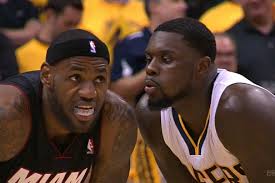
When Stephenson allegedly shoved his girlfriend down a flight of stairs, the Pacers stuck by him.  When he was outed by a prostitute miffed at Stephenson’s refusal to pay for services rendered, the Pacers stuck by him.  When he poked the bear by blowing in LeBron James’ ear, the Pacers bristled but continue to profess their love and admiration.

Click here to follow Kent Sterling on Twitter

Today, Stephenson will begin the real work of deciding whether he will sign a deal to continue his career with the team that embraced his talent and politely encouraged his maturity or jump for more money.

The Pacers are not allowed to spend beyond the luxury cap threshold, and that means team president Larry Bird will be restricted as to how much of owner Herb Simon’s cash he can throw at Stephenson.

Stephenson might jump to the highest bidder after putting together his best season yet.  All that talent and promise is developing, and it leaves many wondering where the ceiling might be for the guy who has been the most talented player on the roster since he walked through the door at Bankers Life Fieldhouse four years ago.

Some see a comparison with Ron Artest as a reason to balk at signing Stephenson, but I think the Artest/Stephenson equation is spurious.  They share several traits in their backgrounds, and play an enthusiastic and brash brand of basketball, but I have never thought Stephenson to be mentally unstable or ill as has been the case with Artest.

Does Stephenson selfishly poach rebounds and react angrily when a teammate refuses to shoot after one of his passes that might have resulted in an assist?  Sure.  He can be petulant and myopic, but if he can continue to move forward as far over the next four years as he has the last four he has a chance to be a star and champion.

If the Pacers are unable to sign Stephenson, the guys on the roster might get along a little better, but since when is that a prerequisite for success?  For each championship team that loves each other, like the 2013 Boston Red Sox, there is at least one that couldn’t stand the sight of one another – the Oakland A’s of the early 1970s come to mind.

The Pacers would not be nearly as talented without Stephenson regardless of who they sign, and as so often is the case, the devil you know beats the devil you don’t.

Talented devils are in short supply this offseason despite everybody and their brothers opting out of player options.  LeBron James, Dwyane Wade, and/or Chris Bosh are not coming to the Pacers.  Carmelo Anthony isn’t either.  Dirk Nowitzki is staying in Dallas.  Pau Gasol is going somewhere else.  Eric Bledsoe is restricted and unlikely to move from Phoenix.  Chandler Parsons is likely not going anywhere, and would likely cost as much if not more than Stephenson for less productivity.

Gordon Hayward is a restricted free agent, who might be offered the max – which is outside the Pacers budget.  Luol Deng?  Trevor Ariza?  Shaun Livingston?  None offer the current all-around game or future promise of Stephenson.

Click here to make the best dentist in Indiana your dentist – Dr. Mike O’Neil of Today’s Dentistry

Not signing Stephenson would almost certainly result is a step away from championship level basketball for the Pacers – hence Bird’s keen interest in getting the deal done.

The debate is not whether the Pacers need Stephenson or if Stephenson needs the Pacers, but whether an agreement can be stuck to make the deal financially feasible. If not for the Pacers, Stephenson may have washed out due to his immaturity.  If not for Stephenson, the Pacers would be a bunch of nice guys struggling to win 50 games.

Stephenson as a Pacer for life is best for everyone involved, but lots of money tends to skew vision toward the silly.

Ed O’Bannon Trial – NCAA’s assertion that amateurism is fan magnet is unsupportable

by Kent Sterling

It's been 19 years since Ed O'Bannon played college basketball, and it might be another 19 before a ruling in his lawsuit becomes enacted.

It’s been 19 years since Ed O’Bannon played college basketball, and it might be another 19 before a ruling in his lawsuit becomes enacted.

Over the course of the last week, I have heard the following quote at least a dozen times, “The arc of the moral universe is long, but it bends toward justice.”  It has been used to describe the need for reparations to African-Americans whose ancestors were slaves, the plight of gays in Uganda, and the NCAA business model that has championed the canard of amateurism as a primary audience magnet.

Over the course of the last three weeks, many bizarre justifications for the NCAA’s refusal to allow athletes to profit from the licensing of their own image have been proferred during the Ed O’Bannon trial, but the most ludicrous was offered during the testimony of Dr. Daniel Rubinfeld, the NCAA’s chief economist.  He claimed that the popularity of college football and men’s college basketball is due to the amateur status of the athletes.

Click here to follow Kent Sterling on Twitter

My head almost popped off when I read his supposed belief that college sports are more popular than minor league sports because fans appreciate those players who are engaged in competition because of their love of the game, rather than cash.  Why those same fans overlook the exorbitant salaries paid to coaches as opposed to the meager wages of professors is a question that prompts incoherent mumblings.

An extension of the NCAA’s logic about the value of amateurism would be that English classes where students love the class so much that they actually go into their own pockets to attend would be even more popular on television.

I’ve heard the “magic of amateurism” argument before, and I have always felt insulted by those who made it.  Just because illogic is spoken by smart people doesn’t make it true or right.

People enjoy college football and men’s college basketball, buy jerseys and tickets, and watch on television by the millions because of a sense of belonging to a specific university either through current or previous attendance, or through residence within that geographic region.  There is also an issue of success that drives interest that has nothing at all to do with whether an athlete receives money in a trust for their licensing that is released upon graduation.

There is also a measure of the quality of play that is brought to bear.  There is no minor league football to speak of, and minor league basketball has long been a disorganized mess.  College football is a de facto minor league, as is college basketball.  Minor league baseball is more popular than college baseball because players in minor league baseball are affiliated with a popular major league franchise, and the baseball is played at a higher level.

Arguments made by the NCAA in the O’Bannon trial have been ridiculous to the point that it’s impossible to believe anyone could make them straight-faced.  Amateurism as a siren song for fans is among the nuttiest, and the assertion that fans will be distressed or repelled by players sharing in the exploitation of their images is not only unsupportable – it shows the low level of esteem these autocrats have for their audience.

Click here to get your teeth fixed by the best dentist in Indiana – Dr. Mike O’Neil of Today’s Dentistry

Discovering truth always involves following the money, and the money leads to the core of why sustaining the status quo is so important to the member institutions of the NCAA.  Cash builds buildings, and buildings allow a school to gain prestige, and prestige attracts more students at a higher tuition rate, and that prolongs the tenure of the administrators who run the universities that run the NCAA.

The O’Bannon trial will be resolved in the short term by the ruling of U.S. District Judge Claudia Wilken, and then there will be a set of appeals that will stretch for years regardless of who wins because the NCAA wants current rules to remain in place as long as possible, and O’Bannon knows he is right.  No one will back down.

For the NCAA, the game is to kick this can down the street for as long as they can.  With a little good lawyering, NCAA president Mark Emmert will be able to retire without presiding over the coming sea change that occurs when that oft quoted arc of justice finally bends toward the athletes doing the work resulting in huge revenues, bloated salaries, and shiny buildings for those in charge.

Indiana Basketball – Peter Jurkin’s transfer leaves more questions unanswered

by Kent Sterling

Moments like this were few and far between for Peter Jurkin.  In fact, in two seasons he never made a field goal in only 18 minutes of play.

Moments like this were few and far between for Peter Jurkin. In fact, in two seasons he never made a field goal in only 18 minutes of play.

Just two days after rolling out the Indiana University’s athlete’s bill of rights, yet another basketball player’s scholarship will be recovered by the program that stumbled through a 17-15 season, ending minus a postseason tournament appearance.

The explanation for Peter Jurkin’s transfer from Indiana University’s basketball team was that he wanted more playing time.  That’s usually at the root of a player’s decision to play elsewhere, so it wasn’t a surprise.

Click here to follow Kent Sterling on Twitter

Why he felt that more minutes couldn’t be had with the Hoosiers is a valid question as he is one of only two returning players with the size to play the pivot.  A victim of recurring injuries, Jurkin’s minutes have been sparsely awarded through his first two seasons, but if healthy he would have been a nice tool for coach Tom Crean.

Evaluated individually, the abandonment of players from the Hoosiers is easily explained.

Austin Etherington was able to gain immediate eligibility at Butler – the program for which his father played.  Etherington never appeared a good fit in Bloomington, and enjoying his final season of college hoops at Hinkle Fieldhouse makes sense.

Jeremy Hollowell’s move to Georgia State to play with longtime summer teammate R.J. Hunter for coach Ron Hunter was similarly sensible.  Hollowell wasn’t comfortable at IU, and was a mistake in recruiting.  Playing system basketball is not a lot of fun for Hollowell, and after two years of slogging through that unpleasantness, he decided to move on.

Jonny Marlin transferred from Indiana despite playing a little bit as a walk-on.  He’s a solid player, but behind a roster filled with guards he was destined for a good seat for games and a ton of work on the scout team if he stayed.

Joe Fagan is pursuing an education that he would like to see end in medical school, and basketball is a serious time eater.  Another walk-on, Fagan making education his priority is a solid explanation for bolting.

Noah Vonleh leaving for the NBA is the most justifiable of all reasons to jump ship.  Making it to the NBA as quickly as possible has always been Vonleh’s goal.  He didn’t re-class to leave high school a year early because he was in a big hurry to play in Assembly Hall.

Those five who have left the team combined with the four graduates (Evan Gordon, Will Sheehey, Jeff Howard, and Taylor Wayer) leave the Hoosiers with seven returning players from a team that can be generously described as mediocre.

Jurkin moving on reduces the number of players remaining from the self-proclaimed “Movement” recruiting class of Ron Patterson, Peter Jurkin, Hanner Mosquera-Perea, Jeremy Hollowell, and Yogi Ferrell to just two after two years.

Transfers aren’t inherently bad for a program, but when they occur in such bulk, questions about the direction of the program are justifiably asked.

The positive of Jurkin leaving is that there are now two scholarships available for the very talented 2015 class.  The bad news is that the Hoosiers will have only 11 players on scholarship, and no senior leadership for a season where Crean needs more than the 17 wins earned last season to quell the increasingly persistent chatter among reasonable alums and boosters about the potential for a coaching change.

From the outside looking in, the work done to rebuild the program after Kelvin Sampson and Rob Senderoff did their level best to destroy it appears to be unraveling.  It’s possible that a lineup consisting of a combination of Ferrell, James Blackmon Jr., Troy Williams, Stanford Robinson, Robert Johnson, Devin Davis, and Mosquera-Perea could achieve significant success.  There is also a chance it can’t.

Indiana Basketball is at a crossroads.  The mass abdication by undergraduates might have a positive result, but that doesn’t necessarily resolve the questions of why so many players are willing to walk into Crean’s office to announce their intention to quit on their dream of playing in Bloomington.

While the work by Crean needed to re-boot the Hoosiers program in 2008 was Herculean, getting the wheels back on the rails in 2014-2015 may be an even tougher challenge.

Hosting three hours of Sportstalk each day from 3p-6p on CBS Sports 1430 teaches a surprising lesson

by Kent Sterling

kentThe challenge of creating from whole cloth a three-hour sportstalk radio show each weekday is much more fun than I thought it would be – and I thought it would be a riot.  That is what surprised me most during the first week of hosting the Kent Sterling Show (catchy name) Monday-Friday from 3p-6p on CBS Sports 1430.

I know from my days coaching talent that there are four qualities to a great radio show – authenticity, relevance, innovation, and fun.  People often believe fun is a self-indulgence that means talent should do cartwheels through their time on the air and not give a damn about the quality of the show.

I have heard a lot of that kind of radio over the years, and have no interest in it as a listener of host.  That’s not the kind of fun I want to have because it’s tedious for the listeners, and the last thing I want is to be tedious.  The fun in hosting for me is in blocking the 12 segments of the show everyday to make sure we are sharing something interesting about sports during every segment.

Click here to follow Kent Sterling on Twitter

The performance of the show is the best time I can have, and I can’t imagine that changing.  Talk radio is a weird beast of a high wire act.  Sharing perspective, getting guests to speak freely in a way that enlightens, and doing stuff that surprises and delights is as engrossing a dare as I can imagine.

My road to hosting has been unique to say the least.  Not many go from producer to manager to talent over the course of 20 years, but it’s probably for the best it worked this way for me.  Running a department of talented people has brought me empathy for coaches I never would have developed otherwise, so when I talk about the potential differences in a team’s direction between Frank Vogel and Larry Bird, Chuck Pagano and Ryan Grigson, or Tom Crean and Fred Glass – I’ve been there.  I’ve sat across a desk telling my boss that he was wrong, and I’ve had it done to me.

Being on the opposite side of cultural difference with a guy who can fire you is difficult terrain that can gnaw away at your soul and cause a disruption in your moral compass the first time through.  And it’s no easier trying to convince an employee of your own of the need to adapt to a new outlook when you know that refusal will likely result in firing.

Players and coaches are trying to provide for a family during what is often a very brief period of time in professional sports, and the stress is beyond intense.  Fans look at the guys on the court or field, and see idols, but they are also employees, fathers, sons, and brothers.  Coaches are middle managers.  GMs are middle managers too.  In fact, everyone in the Pacers and Colts front office not named Simon or Irsay is in middle management.

None of that is why I love getting to the studio everyday, but it is one of the qualities that makes the show unique.  Dan Dakich’s show on 1070 the Fan is unique in the same way.  He has resigned, been fired, fired others, and cajoled and prodded employees.  He’s been treated well and poorly, and he’s done his best to treat others well as individuals while keeping himself focused upon the good of the team.  That brings empathy and understanding.

I wish the week had been filled with nothing but great segments, but sadly I droned on and on for nearly two minutes about Vanderbilt’s athletic department yesterday, and finally had to yell briefly at myself for a monologue that appeared to have no end.  I could literally feel the disinterest of thousands of people in their cars as I pontificated about a university five hours south in which 99.2% of Hoosiers have no interest.  In my mind, I saw listeners banging their fists on the dashboard trying to get me to stop.  So I did.

Instead of guests like Pat McAfee, Stephen Holder, Pete Rose, Chris Copeland, Joe Reitz, Brandon Miller, Bob Kravitz, and so many others, I think about that one blown opportunity.  I guess that’s what causes learning.  Hope it doesn’t happen again.  Listeners deserve better.

Giving people a reason to listen and come back is the goal every time we pop open the mic.  Nick Bosak is my producer, and we see every segment as being in front of an audience.  Mailing it in is disrespectful even for a moment.

Perfection isn’t an option, and the learning is constant, as is the motivation to always  provide something cool for listeners who trust us with their time.

Indiana Pacers deal #57 pick to the New York Knicks for cash, and Larry Bird wants changes

by Kent Sterling

While the Pacers played softball for the Indiana Children's Wish Fund, their boss dealt pick 57 for cash.

While the Pacers played softball for the Indiana Children’s Wish Fund, their boss dealt pick 57 for cash.

For over four hours, seven of us sat in the Indiana Pacers media room waiting for team president Larry Bird to pull the trigger on a move to bolster their roster.  TV crews were absent.  Radio hosts, minus me, nowhere to be found.  Lots of pizza, few mouths.

The writing was on the wall that the Pacers would not upset the 56-win, back-to-back Central Division Champion, almost everyone under contract Indiana Pacers apple cart.  Bird seemed likely to pass on the chance to turn back any of his cards for fresh ones.

But no one thought they would come away completely empty after a long night of watching other teams restock their shelves.  The Pacers entered the night with the 57th pick, and at the very least, they would at least grab the rights to some heavily consonanted Euro.  That wouldn’t be thrilling news, but it wouldn’t be nothing.

Click here to follow Kent Sterling on Twitter

In the end, it was nothing as the Pacers swapped their lone pick for cash.  The Knicks evidently had their eyes on Frenchman Louis Labeyrie, and the Pacers didn’t, so owner Herb Simon gets some walking around money instead of the rights to a guy whose name sounds more like a character on “Hogan’s Heroes” than the future piece to an NBA champion.

Bird said after the draft that the Pacers had their eyes on a guy who went a “couple of picks” before, but when he was gone, they decided nobody would be as good as the remaining somebodies.  A couple of minutes later, Bird amended his remark to “a few picks earlier,” which I took as an admission that he was too specific about which guy they really liked.

The pick two picks earlier – Semaj Christon.  I’ve wanted to ask Semaj for a long time why his parents named him “James” spelled backwards, so that’s disappointing.

Bird was also very direct in his criticism of the manner in which Pacers assets were deployed last season.  He expressed love for his players many times in his 10 minute Q&A with the surviving media, but there was no such declaration of affection for Frank Vogel, who was never mentioned by name, but was evoked several times as Bird decried hot players being replaced, a lack of accountability, and the sparse deployment of Lavoy Allen.

Allen was the forgotten man on the Pacers roster following the trade that brought him over with Evan Turner from the Sixers for former all-star Danny Granger.  Bird mentioned him twice by name as a guy the Pacers would target to re-sign.

Conrad Bruner found that odd, and asked the question that was rattling around my head too.  “What the is your point in discussing a guy as a free agent target who never played an important minute as a throw-in who was used to even up the salaries so the Pacers could get Evan Turner?”  Conrad is too polite to ask it like that, but the point that was confirmed by Bird was that he believes Allen should have played a significant role, but didn’t.

Whose fault could that be other than Vogel’s?

Click here to make your teeth whiter and healthier at Today’s Dentistry

Throughout the small gathering, Bird was disappointed but good humored, until he began to talk about asserting accountability, letting hot players roll, and finding meaningful minutes for Lavoy Allen.  During those moments, Bird bristled a bit and looked like a man who is still smarting over the Game Six elimination his team suffered at the hands of the flawed Miami Heat in the Eastern Conference Finals.

These are all inferences I’m making about Bird’s dissatisfaction with Vogel, but if I were Vogel I would pay close attention to following the not so veiled advice of his boss because he sure as hell seemed committed to holding Vogel accountable if the rotation is not relaxed, if players are not penalized for bad acts, and if Allen is a relentless DNP-CD.

Bird is committed to what he knows to be the best route to sustained success, and if Vogel doesn’t follow that path to the letter, someone else might.

NBA Draft – Indiana Pacers draft 57th tonight, and odds are it won’t mean a thing

by Kent Sterling

Herb Simon and Larry Bird may make some noise tonight, or they may stand pat.  We will learn something about their plans for 2014-2015 either way.

Herb Simon and Larry Bird may make some noise tonight, or they may stand pat. We will learn something about their plans for 2014-2015 either way.

“In 49 states, it’s just basketball – but this is Indiana!”

“In 29 cities, the 2014 NBA Draft holds promise for improvement, but this is Indiana!”

Of the 30 NBA franchises, the Indiana Pacers will wait in line behind all but the five teams without any picks at all for their chance to make roster improvements.  Dallas, Brooklyn, New Orleans, Portland, and Golden State will have even duller draft nights than the Pacers – barring trades.

Pacers president Larry Bird will take calls as teams are eager to trade, but the motivation around the NBA for deals appears to be to clear cap space to join the bidding for LeBron James, Carmelo Anthony, and lesser free agents.

Click here to follow Kent Sterling on Twitter

The Pacers aren’t a great partner for deals that would help teams accomplish that as they have cap issues of their own, but that doesn’t mean Bird won’t pull the trigger on a deal.

Barring a trade, the Pacers will sit around waiting to make what will very likely be an irrelevant selection to all but the kid who is picked.  For him, it will be a thrill.  For fans, it will likely result in a collective “Who?”

Of the past 15 men chosen with the 57th pick, only Manu Ginobli and Marcin Gortat have risen to a level of importance in the NBA.

It’s not like the Pacers are completely wasting their breath as they utter the name of their guy, but there sure as hell won’t be a press conference tomorrow in the grand entrance of Bankers Life Fieldhouse to introduce the kid.

Even if the Pacers held on to the pick that Phoenix now holds at #27 (the result of the trade that brought Luis Scola to Indiana last offseason), the odds of netting a player there who would provide short-term help would be very long.  While experts claim this is a good draft, the 27th pick is going to allow the Suns to choose from players like Jerami Grant, Kyle Anderson, and Artem Klimenko.  Maybe one of those guys will be an NBA all-star, but the odds are against it.

Today will be interesting for Pacers fans because inactivity will likely mean a 2014-2015 with the core of the two-time Central Division champs returning intact for another run.  A trade of key parts will mean retooling has begun.

While no one was thrilled about the way last season unfolded after the brilliant 33-7 start, the Pacers were still able to post the best regular season record in the Eastern Conference (56-26), and advance to the Eastern Conference Finals for the second straight year.

Click here to make Dr. Mike O’Neil your dentist!

The season was not good enough for fans lured into building wildly high expectations by the fast start, or front office staff who continually said that the goal was a trip to the NBA Finals, but there are 13 teams in the East who would swap spots with the Pacers right now.  If LeBron James bolts from Miami, that will add a 14th team that would happily exchange recent pasts, presents, and immediate futures with Indiana.

Tonight might be boring for the Pacers, but winning draft night again and again has done very little for teams like Portland and Cleveland.  Winning doesn’t count until Late October.