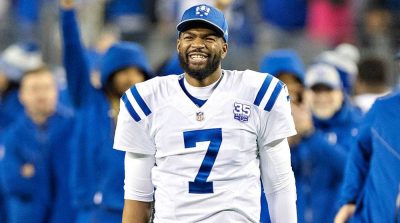

Barring injury, Philip Rivers will replace Jacoby Brissett as the starting quarterback for the Indianapolis Colts.
When I watched a video of four black NFL pundits, including ESPN’s Domonique Foxworth, agree that Philip Rivers is replacing Jacoby Brissett as the Colts starting quarterback because of racism, I winced.
The four experts were not in perfect alignment about the role racism plays in the evaluation of NFL quarterbacks, but all agreed it exists.
I got mad for a few minutes. “Why does it always have to be about race to blacks?” I asked myself. Then I looked in the mirror and realized the answer to that question is not mine to offer.
I don’t understand the signing, as Rivers best days are almost certainly behind him and Brissett’s best days are likely coming in the near future. Rivers is going to earn $25-million in 2020 as the Colts starter because of who he was – not who he is likely to become. It’s hard for me to ascribe the signing as racially motivated though. I hate racism, and cannot fathom the Colts do business with an eye toward the color of a QB’s skin – especially a year after signing Brissett to a two-year deal worth $30-million.
Within 24 hours of watching the video where Brissett’s single year as the starter was discussed, I read a piece in the Indianapolis Monthly by Dan Wakefield. In it he discussed his recent understanding of the discrimination against blacks that has existed silently under his nose in his hometown of Indianapolis for his entire life.
Wakefield wrote of the tragic and sad end to his friendship with African-American writer James Baldwin as the result of a racially dismissive comment made by Wakefield at a dinner. He lamented that he didn’t fully understand that a concept like racism is defined by our individual experiences rather than as a universally agreed upon concept.
Every reasonable human being decries lynchings as horrifying. The Voting Rights Act of 1965 attempted to end an overt act of racism. Recent protests against the murders of unarmed blacks by police point to another chapter of racism. Whites and blacks together understand murder and denying the right to vote is wrong.
Whites, including myself, fail to acknowledge unique challenges faced each day by blacks. We can’t understand how subtle racism works because we don’t live it. Whites see their lives as challenging and express pride in their ability to overcome adversity. Success is hard to find for everyone, we believe. It’s tough out there, and those who use race as an excuse for not finding it are not fighting hard enough. That was basically the message from Wakefield to Baldwin that caused their friendship to immediately immolate.
This is not about whether the Colts are an organization that embraced racism by signing Rivers as the starter over the top of Brissett. It’s about four smart black men with NFL expertise believing racism plays a role as whites in front offices evaluate black quarterbacks. These guys have experiences different from mine.
That doesn’t make them right and me wrong. it also doesn’t make me right and them wrong. Racism is assessed through each of our own experiences and the lessons of our families through generations of unique experiences. No matter how evolved our ability to empathize, we can’t fully understand the black experience and their response to societal norms we accept as fair and equitable. Similarly, they cannot understand how we interpret their appraisal of the Colts actions – or those of organizations run by whites.
I have no doubt Colts general manager Chris Ballard and his staff did everything they could to view Brissett’s work in 2019 through a colorblind prism, but that doesn’t count for much among the four guys who applied race as a factor in his demotion.
You see it one way. I see it a differently. Those four each see it in their own individual way. Racial differences divide us, as do those of gender and religion. And they always will.
The best we can hope is that each of us grasp that because all our experiences have been unique, we each have an equally unique understanding of the effects of race upon each of our lives. And so we need to accommodate the tremendous disparity in beliefs driven by those experiences.
Was Brissett passed over because of his race? There are many answers – none globally correct, but each accurate through our own unique prism.