Author Archives: Kent Sterling

After Bad Loss to 49ers, St. Louis Rams Remain a Franchise in Turmoil

by Kent Sterling

Rams quarterback has some explaining to do.

Rams quarterback has some explaining to do.

Not sure how many seemingly good drafts it takes to build a roster capable of winning, but evidently the last two haven’t been enough.  Ram General Manager Les Snead continues to sign free agents who have played well in the past, and have even played well for the Rams, but aren’t close to getting the job done now.

Click here to follow Kent on Twitter

Running the ball 19 times for 18 yards last night against the San Francisco 49ers was as putrid an offensive display as I’ve ever seen.  Minus a seven-yard gain long after the game had already been decided, the longest gain running the ball was three yards, and that spot might have been a little generous.

Quarterback Sam Bradford wasn’t part of the solution either, completing 19-41 passes for 202 yards.  He showed the lack of feel inside the pocket that has become his defining feature.  Averaging 4.9 yards per pass is an anemic number that defies the respect shown to him by the Rams coaching staff and front office.

This wasn’t the Steel Curtain defense the Rams were playing against either.  With all-world linebackers Alden Smith and Patrick Willis playing last Sunday, the previously soft Indianapolis Colts smashed the 49ers in the mouth and dominated in Candlestick Park.  With Smith in rehab and Willis shelved with a groin injury, the Rams looked baffled and soft the entire night.

It was hard to tell watching the game live whether the Rams offensive line didn’t know who to block or simply can’t block. Looking at the tape, the worst answer is revealed.  It’s both.  The backs serve as little more than a speed bump for blitzes, and tight ends Jared Cook and Lance Kendricks appeared to feel that blocking is not what they get paid to do.

This was a must win for both teams, but only one showed up.

If it wasn’t for Jeff Fisher’s pedigree as a coach, it would be easy to look at the last two games and assume that he has lost his players – that they just aren’t playing for him.  It is also easy to assume that the coordinators have no idea what they are doing and are being outwitted by their counterparts.  Now, that might be true.  It’s hard to say without being in the room, but the Rams have appeared ill-equipped against the Dallas Cowboys and 49ers to stop the run or run the ball.

Blame lies somewhere, and the fatal combination of being unable to move or stop the ball needs to be corrected immediately, or the Rams are looking at yet another disastrous season for a fanbase that won’t tolerate much more awful football.

St. Louis is a soft NFL town to begin with, but this decade of mediocrity, and I am generous in my choice of words to describe the last 10 seasons, the Rams might just permanently turn off the town.

A couple of quick questions that need to be answered –

  • How has the need for a running back not been addressed?  The Colts made a bold move to address a deficiency there, both in free agency by signing Ahmad Bradshaw to a low-risk, high reward deal, and then dealt for Trent Richardson.  Sure, there were no holes for Daryl Richardson, but at least Bradshaw and Trent can slow down a blitzing linebacker.  Why couldn’t the Rams get similar deals done?
  • Why can’t Jared Cook and Lance Kendricks block?
  • What the hell is going on with Cortland Finnegan?  Has he lost two steps or has he found Buddhism and lost his will to be violent?
  • Why could a Colts offensive line that hasn’t created a hole for a running back in 15 years shove the 49ers around, yet five days later the Rams ran one time last night for more than three yards?
  • How in the name of logic could the Rams talk about extending Sam Bradford’s contract?  Yes, he has a nice arm, but he missed throws last night and was statue in the pocket far too often.  He rushed throws that didn’t need to be rushed, and waited too long to make others.
  • How is Matt Giordano getting playing time at safety?  Few teams put themselves in position with a roster to knowingly be deficient in that profound a way.  Giordano is Craig Dahl.

The season isn’t over for the Rams, but imagining a scenario where the group on the field last night can compete against an NFL team not the Jacksonville Jaguars requires a double dose of peyote.

Running back Frank Gore ran 30 times for 60 yards in his first two games, and minus one drive against the Colts in his third was mostly inert.  Against the Rams, Gore gashed for 153 on 20 carries.

How long does St. Louis need to wait for a team that will show up and compete?  Either the Rams don’t have the talent, the heart, or the brains to win.  Maybe losing is so ingrained in the DNA of the franchise that new rosters, coaches, and front office personnel can’t steer it away from the icebergs that continually crop up in its path.

It’s still September, and three quarters of the season remain, but it’s hard to imagine a turnaround so radical that the 2013 season can be saved.  This five-day span with two bad beats might be the worst any team has played in the Super Bowl era, but Rams fans of the last ten years would be better judges than I.  They lived through the worst five-year stretch in NFL history (15-65 from 2007-2011).

I thought Fisher and Snead were the guys to get this job done.  Maybe they are.  If the Redskins keep losing, the Rams might have yet another two early picks in another draft.

Loser of St. Louis Rams vs. San Francisco 49ers Game Tonight Is Facing a Lost Season

by Kent Sterling

imagesTonight’s game at the Edward Jones Dome between the San Francisco 49ers and St. Louis Rams will be an early and final referendum on the 2013 season for one of those two teams who to this point have underachieved.

The winner will get back to an even money 2-2, and the loser will be looking at the business end of a 1-3 record without a lot of hope for redemption.

Both teams gave miserable efforts last week.  It’s rare that NFL teams simply don’t compete on a Sunday, but last week the 49ers lost 27-7 in Candlestick Park against a determined Indianapolis Colts rushing attack.  The Rams traveled to Dallas and were humiliated against the Cowboys 31-7.

Click here to follow Kent Sterling on Twitter

For the Rams, that game was the first time that the team failed to fight during the 19 games played under Jeff Fisher.  The Rams have enjoyed some successful drafts, and were able to sign several big free agents.  The feeling inside the halls of the Rams Complex in Earth City, Missouri, was that coming off a 7-8-1 2012 season, they were ready to take another leap forward.  Someone should have told James Laurinaitis, Chris Long, and Cortland Finnegan, who have all underperformed through three games.

The 49ers are led by a quarterback who was anointed the next big thing after starting only 10 starts.  Colin Kaepernick was said to have all of the tools to be among the best the NFL has ever seen, but over the last two weeks looked less than ordinary against the Seattle Seahawks and the Colts.

Kaepernick’s numbers over those two games are eerily similar.  Against the Seahawks, Kaepernick went 13-28 for 127 yards and three picks.  Four days ago against the Colts, he completed 13 passes again in 28 attempts with only one pick.  His quarterback ratings were 20.1 and 49.9.  Yikes!  The game in Seattle was thought to be an outlier because of the miserable conditions in Seattle for opposing offenses until the Colts game in SF.  Now, Kaepernick needs to rebound, or people will speculate that defenses have caught up with him.  The truth is more likely that his receivers are now minus playmakers, and the result a gunslinger without bullets.

The 49ers have 28 players listed on their injury list, and if tight end Vernon Davis can’t go tonight, they will be in the same weaponless boat against the Rams that they found themselves in against the Colts.  Aldon Smith is in rehab battling his addiction, Nnamdi Asomugha is out with a knee, Patrick Willis is questionable with a groin, and the 49ers will have to scrap for a win

The Rams health is much better than the 49ers.  No one is listed as out or doubtful.  WR Chris Givens, OG Chris Williams, DL William Hayes, RB Daryl Richardson, back-up TE Mike McNeil, and RT Rodger Saffold are all questionable.  If Saffold can’t suit up, Joe Barksdale has been effective in his stead, and is the likely future right tackle next year.

One thing that even during lackluster losses that couldn’t be said about the Rams last season is that they didn’t compete, but last week, they just did not show up.  Prior to last week, running back DeMarco Murray had gone more than a year since running for more than 93 yards in a game.  He gashed the Rams for 175 yards – the second highest total of his career.  The best day – the best in Cowboys history – came on October 23, 2011 when he ran through holes that were more like rivers of green for 253 yards against the Rams.

Murray has played 26 games, and has run for 1,846 yards.  Two of those games have been against the Rams, but have accounted for 428 yards  – or 23.2% of his total.

Enough about the unfortunate performances in Dallas.  The Rams badly need this game to stay in the hunt for their first winning record since 2003.  For that to happen, the running game need to generate what people in football like to call yards.  Other than quarterback Sam Bradford, no Rams running averages more than 3.3 yards per carry, and their team average of 3.2 yards per carry ranks 29th of 32.

To this point in his career, Bradford has not been dynamic enough to be carry the offense without a little help from the running game.

Offensive coordinator Brian Schottenheimer has come under fire for not putting the offense in a position to succeed.  Rams fans are quickly tiring of watching running backs get destroyed in the flat after easily sniffed out swing passes.

While neither Rams coordinator has distinguished himself thus far in 2013, the problem in Dallas was that they were physically beaten by the Cowboys.  If Fisher was successful in getting their attention during a short week, the Rams have a chance against a decimated roster to send the 49ers home 1-3.  Otherwise, the Jones Dome will empty early and rightly so.

It’s time for all these high draft picks to play like it.  The only plus side for the Rams with a loss is gaining another couple of draft positions.  With the Redskins first round pick – they are without a win – and their own, the Rams can grab another two pieces to the puzzle, but fans have seen what that puzzle has looked like before.

The game will depend upon the Rams ability to stop Frank Gore.  Without Gore being effective, the 49ers couldn’t score against an ordinary Colts defense at home.  If Gore runs as well as the marginally talented Murray did for the Cowboys, fans will head across the street to the casino with plenty of time left on the clock.

Pick: Rams beat the 49ers 23-7.  Sounds nutty, but given the injuries, the Rams are a much better team today than the 49ers.  There is no way that Fishers hasn’t realigned the mentality of his team, and given what the Rams have learned from the schemes of the Seahawks and Colts, they should be able to keep Kaepernick in the pocket long enough to create problems.

NCAA Football and College Basketball – Why Not Pay Players to Their Value?

by Kent Sterling

Big Ten Commissioner is a really smart guy, and he said some interesting things yesterday.

Big Ten Commissioner is a really smart guy, and he said some interesting things yesterday.

Why is it inherently bad to pay college athletes commensurate to their value?  Other than it never being done – at least not above the table – is there any justification for not allowing basic economics to operate unfettered for athletes whose work makes a lot of money for everyone associated with college football and men’s basketball other than themselves.

If college athletics is truly about education, it doesn’t make sense to pay coaches like Alabama’s Nick Saban and Kentucky’s John Calipari more than $5 million per year to “educate their student athletes.”  There are coordinators for big time college football programs who earn more than $1 million per year.  That’s a lot of cash for the equivalent of an associate professor.

Click here to follow Kent Sterling on Twitter

The problem with college athletics is that you can’t walk into a stadium or arena without tripping over the hypocrisy created  by greed and the coveting of championships, and make no mistake about the coveting of championships leading straight back to money.

Football and men’s basketball are the most effective marketing efforts for the universities fortunate enough to win.  The stadia are filled every fall Saturday, and the arenas are packed through the winter.  ESPN captures it all, and reinforces how much fun it is to attend an SEC, Big Ten, ACC, Big 12, and Pac 12 school.

Baylor estimated that Robert Griffin III was worth a quarter of a billion dollars to the university – not in jersey and ticket sales, but in the overall marketing of Baylor as a destination for prospective students.  The education Griffin received was worth approximately 1/1,000th of that.

In America, people are supposed to be paid based upon their value, and that is more or less true everywhere but in collegiate athletics.

The concept of amateur athletics is strange.  I read a piece this morning on ESPN.com where Big Ten Commissioner Jim Delany made some comments.  I like Delany.  He always has a unique take, and is unafraid to tell the truth as he sees it, so I regularly seek out his published wisdom.  Purdue Athletic Director Morgan Burke is quoted as saying, “Pay for play has no part in the amateur setting.”

There is ‘amateur’ again.  I wondered where this concept of amateur equals purity came from, so I started googling “origins of amateur athletics.”  Interesting stuff.  Restricting entry in events to amateurs began as a way to keep the rabble out, and limit participation to those in the upper class.  If there was no pay, working class stiffs were economically unable to take time off work to train or compete.

The people who are proponents of restricting collegiate athletes from being paid in any way – even going so far as preventing them from owning their likeness – extoll the virtues of playing for the love of the game, and the joy of belonging to a collective larger than themselves.  Sounds a little like a miserable mutation of what Karl Marx proposed in “Das Kapital.”

How many of those people would be willing to sacrifice their income, minus the bare minimum amount to live in order to work?  Maybe the employer could throw in the cost of continuing education for their employees’ trouble.  Yeah, thought so.

Delany, as always, said some interesting things to the media as quoted in the ESPN piece, “If an athlete wants to professionalize themselves, professionalize themselves. We’ve been training kids for professional sports. I argue it’s the color, I argue it’s the institution. If you think it’s about you, then talk to John Havlicek about that, you’ve got to talk to Michael Jordan about that. These brands have been built over 100 years.”

So, it’s the university and not the player that generates the value of the brand, according to Delany.  Then why do coaches at those same institutions get paid outrageous amounts of cash to serve those same institutions?  And the same argument could be made about the 122 professional franchises in American major league athletics.  The Chicago Cubs have been around since 1876.  Cubs fans were Cubs fans whether Frank Chance, Stan Hack, Ernie Banks, Greg Maddux, Ryne Sandberg, or Sammy Sosa played.

Yet Alfonso Soriano earned more than $100 million in six-and-a-half years as a Cubs left fielder.

Delany continued, “I think we ought to work awful hard with the NFL and the NBA to create an opportunity for those folks. We have it in baseball, we have it in golf, works pretty good, we have it in hockey. Why don’t we have it in football, basketball? Why is it our job to be minor leagues for professional sports?”

Great point, but syphoning off the economically disadvantaged among the very talented doesn’t answer the overriding issue of value yields compensation.  One way or another, if a player brings value, he is going to get paid.  Someone somewhere is going to hand cash to a kid whose image is responsible for making more money for others.

That’s Econ 101, and ignoring it is the cause of the bizarre environment that exists today in college football.  Former players are unapologetically saying things into microphones about being paid, and more are lining up to do it every day.

For decades, college football and men’s basketball saw varying levels of corruption, but the basic questions were reasonable.  No one made a ton of cash on the backs of the student-athletes, but with the proliferation of sports networks, the massive payments for the rights of play-by-play, and the incredible popularity of video games and jerseys the money is falling from the sky in Walter White style barrels.

The conference commissioners might want to revisit the money they make.  If the job of college athletics is to educate student-athletes, it’s peculiar that those running the leagues in which these universities play earn millions themselves.  Here’s a list of the three highest paid commishes and their salaries:

  • Larry Scott, Pac 12 – $3,100,000
  • Jim Delany, Big 10 – $2,800,000
  • Mike Slive, SEC – $1,600,000

The trail to the truth is always the same.  Principles have very little to do with the rhetoric.  You must follow the money.  If anyone acknowledges and compensates to the value of the student-athletes, the pile for coaches, administrators, and commissioners shrinks.

Gordon Gekko said it in Wall Street, “Greed works.”  Greed does work, both as a way to make money, and to explain the outrage of those defying logic every time they speak into a microphone.

Indiana Pacers – Paul George Signs Extension, Pledges Effort, Leadership, and Love for Indy

by Kent Sterling

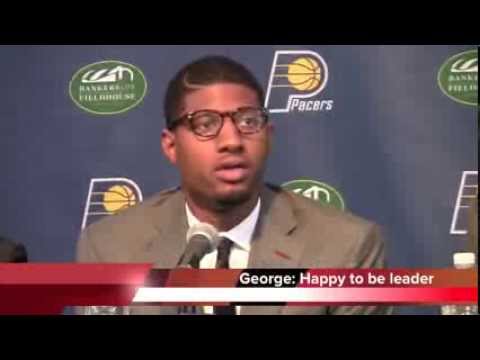
imagesAll people have flaws, but Indiana Pacers President Larry Bird’s willingness and ability to tell the truth are not among his.  When players have disappointed Bird, he has spoken out.  When they please him, that is made clear too.  Today, he was very pleased to talk about Paul George.

Click here to follow Kent Sterling on Twitter

When Bird drafted Paul George after his sophomore season at Fresno State, Pacers fans wanted two things – a description of George because most had never seen or heard of him, and an explanation of why with good players they had heard of still on the board Bird chose this skinny California kid.

The same thing happened in 1987 when the Pacers took a skinny California kid who was better known as Cheryl’s little brother.  That worked out pretty well, and so has George.  It’s worked so well that owner Herb Simon is going to give George at least $80 million of his money to play basketball at Bankers Life Fieldhouse until June, 2019.

Bird was effusive in his praise of George, saying he’s the “real deal” and that he expects George to blossom into a first team All-NBA player.  George professed his love of Indianapolis in a way that seemed genuine.  He spoke of his new house in Geist and how neighbors are going to great lengths to make him feel welcome.

George is an interesting guy in that he appears to be very concerned with three things and only three things – the Pacers winning a championship, becoming a leader in the community, and winning an MVP award.

Tall, long, earnest, and driven are four damn nice traits to possess for a guy with very serious ambitions about basketball. It’s not hard to see that Bird loves the 23 year-old, and wants him to blossom as a marquee player in the NBA.

As you watch the video highlights of the press conference, remember that today will either be the beginning of something great for Paul George and the Pacers, or the day when all of George’s dreams came true and he stopped pursuing them.

My guess is that George is one of the smart guys who knows that money follows the hard work that drives success.  Money isn’t a goal, it’s a result of the work to reach a goal.  Winning is the reward for hard work, and money is the reward for winning.  Time will tell.

NCAA Reinstating Penn State Football Scholarships Shows Lack of True Compass/Leadership

by Kent Sterling

NCAA President Mark Emmert should take the number of times he is asked the same question as a sign that the answers provided by the NCAA are lacking in clarity and consistency.

NCAA President Mark Emmert should take the number of times he is asked the same question as a sign that the answers provided by the NCAA are lacking in clarity and consistency.

What does the NCAA stand for?  Is it an oversight organization that determines athletic eligibility and runs championships among its members, or is it empowered to require universities to behave in the best interests of higher education and competitive balance?

I don’t think anyone at the NCAA headquarters has a clue.  The mission statement for the NCAA on president Mark Emmert’s webpage is, “Our mission is to be an integral part of higher education and to focus on the development of our student-athletes.”  I’m all for brevity, but what the hell does that mean?

Click here to follow Kent Sterling on Twitter

Did the scholarship reduction for Penn State’s football program help the NCAA serve as an “integral part of higher education” or “focus on the development of student athletes”?  If it did, I don’t know how.  What it did was insert the NCAA into a moral guidance role for college football.

Penn State didn’t break any NCAA rules, but when the news broke about former assistant football coach leveraging his access to Penn State University facilities to lure kids into areas where their innocence could be plundered, the NCAA decided to issue a stiff penalty.

Sandusky was allowed to maintain a presence at the university after his pedophilia was reportedly known within the athletic department.  That cast Penn State as an enabler in Sandusky’s miserable and evil existence, and it made the NCAA’s decision all the more justifiable.

There were those who did not like the NCAA penalizing a program based upon the laws of God  and the State of Pennsylvania rather than rules it crafted to maintain a level playing field among universities.  But if making too many phone calls to recruits can cause the evisceration of a basketball program like Indiana’s, how can Penn State football continue to operate when it allowed a pedophile free reign within its halls?

The NCAA took a stand.  It issued a sanction just short of the death penalty that stripped scholarships, bowl eligibility, vacated wins from 1998-2011, and five years probation, as well as levied a $60 million penalty.  And now it restores some of the scholarships as a “reward” for aggressively adopting the recommendations in the Freeh Report when that should have been the goal all along.

Just what in the name of Walter Byers is going on here?  Sandusky mutilated the bodies and souls of trusting children.  Penn State ignored it.  The news was released.  The NCAA tried to recalibrate the passion Penn State University shows for its football program.  The governor of the State of Pennsylvania sued the NCAA.  The son of a coach, who reportedly valued his friendship with Sandusky more than the innocence of the children who were being raped, continues to relentlessly carp about the unfairness of the penalties – particularly the loss of wins that make Joe Pa’s record as a coach appear more ordinary.

Emmert has an interesting quote on his page at NCAA.org, “Then you all go to your Rotary Clubs and say that in college sports we care about amateurism. And they look at you and say, ‘$10.8 billion and amateurism? Help me understand that.’ We have to make sure people know what we stand for and what we care about.”

The problem is not one of communication, but of internal understanding.  Emmert argues with himself, and there lies the rub.  Amateurism is a sham principle used to keep the pot of cash intact for the powerful.  Businesses everywhere have been trying to figure out how to avoid paying employees in the same way universities have with athletes.  The NCAA doesn’t know who and what it is, and so it wanders from kind to stern to generous to stingy.

The NCAA is like a terrible parent, and the universities respond as would a poorly disciplined child.  The rules are indecipherable, and the penalties are unevenly applied.  And then in this case – reversed.  When questioned about the reversal, Emmert says relaxing the scholarship reduction is not a reversal at all, but a reward for compliance.  Talk about terrible parenting.

If the NCAA wants its members to run wild, they are doing a hell of a job of eroding whatever minuscule remaining level of trust in the discipline that is designed to keep members in line.

Predicting the NCAA’s next move isn’t difficult.  Take what makes the least sense, double it, and release it using confusing and vague language.

Indiana Pacers – Paul George Signs Longterm Deal to Stay in Indy Thru 2019

by Kent Sterling

I hope Paul George wears this ensemble at 11a today when his new max deal is announced.

I hope Paul George wears this ensemble at 11a today when his new max deal is announced.

Number 10 was lucky for the Indiana Pacers in 2010.  With the 10th pick of the 2010 NBA Draft, the Pacers drafted a mostly unknown sophomore out of Fresno State named Paul George.

Unimpressed by the consistency that allowed George to score exactly the same number of points (487) in both of his seasons as a Bulldog, the entire city of Indianapolis shrugged its shoulders and yelled “Who?”

Click here to follow Kent Sterling on Twitter

There were much better known players available from mega programs – Patrick Patterson and Eric Bledsoe from Kentucky, Xavier Henry and Cole Aldrich from Kansas, and Ed Davis from North Carolina would have to wait as Pacers President Larry Bird the still growing skinny kid with length and a sweet jumper was the best fit.

Indy knows who George is now, and the Pacers will reward the hard work that has helped launch him into the stratosphere of the NBA’s elite.  Reports are the deal will play George a minimum of $80 million over five years beginning with the 2014-2015 season.

Conventional wisdom was that without a top five pick, the Pacers would be doomed to a purgatory of mediocre rosters because getting a franchise player would be impossible.  It’s not bad logic, but Bird rejected it.

The pick immediately prior to George was hometown hero Gordon Hayward of Brownsburg High School and Butler University.  Imagine how different the Pacers fortunes would be had the Jazz seen in George what Bird did, and Hayward had fallen to the #10 pick.  While Hayward is enjoying a productive career, averaging 10.4 points per game over three seasons, George has become a player on the fringe of being mentioned with LeBron, Dwyane, Kobe, and Durant.

George was voted the NBA’s Most Improved Player in 2012-2013, and for good reason.  Sure, he posted career highs of 17.4 points per game, 7.6 boards, and 4.1 assists, but where he makes his indelible mark is on the defensive end of the floor where he led the NBA in defensive win shares (an estimate of the number of wins contributed by a player due to his defense) with 6.3 – almost a full game more than second place Marc Gasol with 5.4.

And as good a player as George is, he might be a better guy.  It’s never surprising when someone in the Pacers front office says good things about a player, but the effusiveness of the Pacers in describing George’s character is telling.  He’s the kind of guy you put on billboards without worrying that he is going to go play shoot ’em up at the Eight Second Saloon like some of his predecessors.

The Pacers roster is taking shape for the long term, with only Danny Granger, Lance Stephenson, and Ron Howard not signed for the next two seasons.

Going into the offseason, the goals for Bird and his staff were to sign David West, rebuild the second unit, and get George locked in for the long haul.  Done, done, and done.

The second unit looks to be a much improved group over that which lost leads built by the starters throughout last season. Luis Scola, C.J. Watson, Chris Copeland, Ian Mahinmi, and either Danny Granger or Lance Stephenson is potentially as good a second unit as there is in the NBA.  Regardless of where they stack up in league rankings, they are going to be stout compared to last season’s uneven group.

The rebuilding really never stops in the NBA, but the heavy lifting of reshaping a roster that began its overhaul in 2006 with retirement of franchise icon Reggie Miller and the deal that sent Ron Artest to Sacramento appears to be over.  Gone are the talented but difficult to manage knuckleheads, and in is a roster that by all accounts is filled with really good guys who aren’t going to embarrass owner Herb Simon or alienate season ticket holders.

There was some thought that George might decide to roll back out to Los Angeles after his initial contract expires, but he isn’t the first guy from Los Angeles to decide that living in Indianapolis isn’t the worst idea during an NBA career that pays him “Beverly Hillbillies” money.  His $80-$90 million will be as tough to spend in central Indiana as Miller’s millions were a decade ago.

If Granger can stay healthy through the season, the Pacers have a chance to be very, very good.  George Hill, Granger/Stephenson, George, David West, and Roy Hibbert are as balanced a starting five as any in the NBA history of the franchise.  They work hard, like each other, and respect the game.

That could make the Pacers a very dangerous team in June.

Conversation with Mark Boyle Prompts Reflection About Radio Management

by Kent Sterling

Mark Boyle (left, with Bob 'Slick' Leonard) has been calling Pacers games for almost 25 years, and asking honest questions for longer.

Mark Boyle (left, with Bob ‘Slick’ Leonard) has been calling Pacers games for almost 25 years, and asking honest questions for longer.

Indiana Pacers radio play-by-play Mark Boyle is a fascinating guy.  Every conversation involves questions and commentary that are unfiltered.  Talking to him requires focus because if he asks a question, he is genuinely curious about the response.  There are a lot of people who ask questions to be polite, and then check out when the answer comes.

You can tell people like that anything.  Not Mark.

Click here to follow Kent Sterling on Twitter

Yesterday, I walked over to the cool kids table at the post-golf dinner for the Pacers Golf Outing because Mark, Brooke Olzendam, and Kevin Lee were laughing, and I knew that meant they were mocking someone in media.  I wasn’t disappointed.  Mark is one of the great all-time critics (much funnier than the old cranky bastards in the balcony of the Muppets), and Brooke was funny too.

Kevin and Brooke left, and Mark asked, “What are you doing?  Just the website and weekend deal (kentsterling.com and “Ahead of the Curve on 1070 the Fan every Saturday from 11a-1p)?”

I told him that was it for right now, that I’m working hard generating content because I really enjoy that.  Then I told him that I learned to dislike being a part of management over the years.  That was an easy thing to share with Mark because four years ago, I fired him, and surely he would understand my disdain for the people who relish sitting in conference rooms determining the fate of each employee every year – if not more often.

The more complex truth is that I enjoyed some aspects of management a great deal.  Working with talent to improve their performance and consistently become the best version of themselves on-air was endlessly validating.  Seeing something in a board-op, producer, or applicant and giving them an opportunity to talk into a microphone to entertain and inform audiences was always thrilling.

There were occasions when firing people could actually be enjoyable.  If a person was an ass or behaved on-air in a way that didn’t measure up to our brand, I didn’t lose sleep.  It didn’t happen often, but now and again, I fired people for the right reason (anything but money).

More problematic for me was the chore of managing up.  Most people on the programming staff of a radio station, the editorial staff of a newspaper, or the news staff at a TV station believe that the only managing being done by their boss is in making sure their work measures up to their bizarre sense of what he or she believes will compel listening, reading, or viewing.

Unfortunately, just as much time is spent trying to strategize the best route to getting a plan okayed by upper management as assessing needs and putting together the plan to address them.  It’s the job of the department manager to keep upper management from flexing their own muscles and determining course based upon their gut.

For all the dozens of times I heard someone say, “My gut tells me, …” I never heard anything that made sense following it.  My difficulty was never in saying the right thing after that to bring the ship back to the correct course, but in keeping my face from betraying my frustration, dismay, and occasional horror.

For me, moving into management was an easy choice.  I always wanted to be talent, but kept getting more money and promotions to move toward management, and I felt that because of improvisational training in Chicago I had a chance to help talent.  With a son and wife who were kind enough to wait out the lean years, I felt compelled to follow the cash and figure out the rest.  Looking back, I would have been better served doing exactly what I’m doing today.

Most of the managers for whom I worked were or are very smart.  They do their best to keep the ship running smoothly, while trying to do the same thing I didn’t like, and that’s keep crazy from taking hold within a conference room that could derail years of good work.

Because I find it amusing, I’ll relate a story about an idea one of the GMs for whom I worked.  This was a guy from outside the market where I worked at the time who was destined to depart within one year of this piece of genius.  He decided that the radio station would buy a diner, and that out morning hosts would serve dual roles on-air and in the restaurant.  The host would also cook for customers.  The co-host would be the server.  The sports anchor would sit at the front counter and read the sports.  The show would air from their each morning.  Jesus.

Listen to that idea in a conference room without rolling your eyes.

The same GM decided to pair a couple of politically opposed people in afternoon drive.  One, a guy who never wanted to listen to anyone, and hated the idea of a co-host.  The other was a local woman who was sharp enough to know that the guy was a grade A boob.  The GM saw me in the stairwell and told me of his decision.  Looking stunned, I said, “You think that’ll work?”  He turned angry, and told me in no uncertain terms that he did.

I got lucky to have a general manager hired by Emmis with whom my quirky personality was a good fit, but there aren’t a lot of Tom Severinos out there.

The quality of the radio being done by people I worked with and helping get my son through school financially will have to suffice as rewards for a 20-year diversion away from what I wanted to do all along.

I love to create content, and that is where I’m casting my lot.

That’s a much better answer than what I gave Mark yesterday.

College Football and Men’s Basketball – 12 Reforms I Would Enact as NCAA Czar

by Kent Sterling

Can Mark Emmert lead a group to evolve the current mouse trap enough to keep others from inventing a new one?

Can Mark Emmert lead a group to evolve the current mouse trap enough to keep others from inventing a new one?

Athletic governance among big revenue universities is going to change, but it’s going to take time and the result might not position the NCAA to be any more effective that it is currently.

Click here to follow Kent Sterling on Twitter

At this point, fans are starting to pity the NCAA, and they should.  The NCAA is not a professional sports league, and president Mark Emmert is not a commissioner.  Emmert might wish that he was commissioner because fixing things would be much quicker and easier.

The way this beast is built requires that university presidents operate as the de facto leaders, and those pedantic academics are as interested in real reform as car salesmen are in becoming cardiologists.  Real change is difficult, and costly – not in dollars, but in culpability.  University presidents enjoy being university presidents, and they can be removed for two reasons – incredible incompetence and responsibility for the fallout from changes they make.  Being bold and decisive can expose their careers to an untimely demise under one or both of those conditions.

University presidents are also very confident in their intellectual abilities.  They believe seeing complex issues clearly and the plotting a course down the road to success is a talent that God bestowed upon them in the womb, and those university presidents have served as the architects for the system that is currently governing college athletics – the same one they are tasked with correcting.

So when Emmert says – ”I’ve said publicly on a number of occasions the only thing everybody agrees on with Division I governance is that it doesn’t work.  I think the board anticipates a lot of change.  They’re going into their October and January meetings expecting to look at a whole different governance model for Division I.” – he’s really saying that everyone with a seat at the table in those meetings will agree only on the problem, not the solution.

For aggressive solutions to be enacted, each of the presidents who believe him or herself to be the smartest in the room, will have to come to an agreement as to how the NCAA should be structured moving forward.  Good luck with that, Mark.

The changes that will be made can only be those that are agreed upon by a majority, and that system is designed to maintain the current, not nimbly evolve.

I am ready to accept the challenge of boldly leading a new NCAA, and these are the 10 changes I would make on my first day as the czar of the association:

  • Players own their own licensing immediately and forever across the universe.
  • Players will be allowed to sign with agents while in school for the purpose of managing licensing.
  • Schools will be allowed to bid for the services of players.  It already happens, and I am not going to enact rules that cannot be enforced.  The cash is all given over the table in full view.  There will be those who want this money placed in a trust to be accessed only after students graduate, but the logic of that eludes me.  Value demands compensation, and delaying it is silly.
  • Any evidence of academic fraud will result in the immediate lifetime disqualification of athletic eligibility.
  • Coaches will be restricted to a pay scale that mirrors that of professors at the university, but will also be granted tenure just as professors can.
  • All college athletes will be provided a stipend of $100 per week.  The money will be placed in an account that may be accessed with a debit card.  Expenses will be monitored to ensure responsible spending.
  • Players can shoot, lift, meet, and practice without limitation outside the hours of 9a-5p, which are reserved for academics.  Any coach violating the quiet hours will be banned forever from coaching.
  • A compliance monitor will audit each game, practice, and workout to ensure safe conditions exist both physically and emotionally for student athletes.
  • Athletes will be evaluated through the same prism as all students applying for admission to the school.  Each applicant will be admitted based upon criteria that exists across the board.  No special consideration is given to athletes.  If at any time, an athlete is granted entry without meeting the same standards as the general population, that program will be suspended for five years.
  • If a student-athlete does not graduate, the cash value of the tuition wasted is given to the student-athlete.
  • Every scholarship given to an athlete lost to a professional league prior to graduation will be lost until the academic year following what would have been his or her senior year.
  • I like the current rules governing athletic transfers but don’t agree with the inequity that allows coaches to leave without penalty, so we will require tenured coaches to abide by the same transfer rules if they leave one school to coach elsewhere.

I expect none of these initiatives to be adopted as they would completely destroy the status quo, which is not likely to be an agenda item for the meetings scheduled for October and January when reforms will be discussed.

Some would cause problems of their own, but none bigger or less fair than what exists today.

[polldaddy poll=7422338]

Indiana Pacers Golf Outing Should Be a Portend of On Court Excellence

by Kent Sterling

Our group poses with first round pick Solomon Hill (from left - me, Dr. Steve Samuels, Fox 59's Brittany Diehl, and Eddie White.

Our group poses with first round pick Solomon Hill (from left – me, Dr. Steve Samuels, Fox 59’s Brittany Diehl, and Eddie White.

After playing in a couple of hundred corporate golf outings, I can tell you you thing – the companies that sweat the details make the outings much more relaxed and enjoyable for the participants.

Fun golf outing = oncourt success is a simplistic equation that defies a little bit of logic.  After all, my draining a couple of putts has nothing to do with Paul George knocking down shots, but the traits needed to have a golf outing go off without a hitch are very similar to those that govern the culture of a successful company.

The devil is in the details, and those who can execute to a high level of detail that feeds, bevertizes (a perfect term borrowed from former St. Louis Cardinal and current radio host Chris Duncan), and entertains 18,000 at Bankers Life Fieldhouse should be able to do the same for 132 golfer – and vice versa.

The fun at the Pacers Golf Outing has historically mirrored the success of the team.  The Pacers Golf Outing was always a really fun day make in the late 1990s and early 2000s, and then it wasn’t quite so much fun.  Yesterday’s event might have been the best of all.

Sure, the weather was gorgeous.  Not sure a nicer day could have been ordered, and while weather is a detail that can’t be managed, the Pacers staff got the stuff they could control just right.

One thing I very selfishly liked was that the gifts everyone received were excellent, while the prizes for winners were okay. With 33 foursomes playing, to give the winning group – undoubtedly loaded with ringers – a golf trip to Ireland does nothing but piss off the other 32 teams.

Our bounty just for showing up – a pair of very sweet Pacers golf shoes from Adidas.  We got to pick the style, and they will be shipped to us in a few weeks.  I love cool golf shoes, and am not quite as enthusiastic about watching a foursome better at stocking a team win a golf trip.

The food was excellent, the Pacemates were everywhere, and the Pacers themselves were engaging and smiling.  When a head cover of mine fell off, Roy Hibbert retrieved it and drove it back to me.  Then, Roy hit a long putt for us, and gave us a solid line.

Nothing worse than hearing the tales of another man’s round of golf, unless it’s the stories from Eddie White about his golf outings with sports celebrities, so let’s get to what parallels we can draw from the event yesterday, and the season to come.

I’m not sure whether the Pacers players needed to be ordered to show up, but it sure seemed like they enjoyed themselves – and each other.  Camaraderie is very difficult to fake, so I trust that the players get along as well as it seemed they did.

New guys like Luis Scola, Chris Copeland, Solomon Hill, and Donald Sloan spoke before the event, and Paul George, Hibbert, and Lance Stephenson socialized after.  As telling as the way the players enjoyed each other was the genuine fun the front office staff seemed to have.  And that I know cannot be faked.

And is there anything about being the Pacers head coach that Frank Vogel doesn’t just love?  He may be the most normal coach I have ever met, counting high school coaches.  He appears to be embracing every moment of this ride, and I love it.  So many coaches put themselves through such a relentless ringer that they come out completely wasted.  There is no doubt that Vogel works incredibly hard as a road to where he is doesn’t exist without being willing to work 18 hour days, but he seems to be a very normal person.

The Pacers may have lucked into hiring the absolute perfect guy to coach a very unique team of relentlessly good guys.

There was a time when this golf outing seemed like work for the Pacers.  Anyone who has ever taken part in organizing a golf outing knows it’s very difficult to get right, and the only road to guests enjoying themselves is through hard work, but the staff enjoying themselves and each other might be the most important detail of all.

The behavior of the staff that made it seem like great fun to be a part of that team, and when the Pacers have been successful, that vibe was clearly present.  When the Pacers had trouble winning or comporting themselves in a responsible way, the golf outing was a trip to the dentist.

Yesterday, the Pacers comported themselves as a company clearly excited about being a part of a team on the rise – a group that both on the court and in the conference room that can operate at a high level.

Sure, the golf was fun, but I was more interested in whether it was fun for everyone else because that’s better at predicting playoff success as the Farmer’s Almanac is at predicting the weather.

Congratulations to Kevin Bower, Krissy Myers, and Megan Knapp for getting the small stuff exactly right.  When the small stuff is right, the big things being just so is a given.

Ron Howard’s “Rush” Premieres This Weekend; He Talks to Fox 59’s Chris Hagan

by Kent Sterling

UnknownFox 59’s Chris Hagan got a chance to sit down and talk to film director Ron Howard about his latest project “Rush”, and all credit goes to Chris for being able to keep his focus.

The voice and laughter of a TV and film icon like Howard would be impossible for me to hear and not respond to.  There would be no way to hear Opie Taylor, Richie Cunningham, or the narrator from “Arrested Development”, and continue to respond with reasonable questions.  My brain would seize from hearing and seeing it live.

Howard’s films are usually pretty good, and some have been great.  He understands how to visually depict human behavior in a compelling way as well as any director since Frank Capra, and his treatment of the rivalry between Formula One racing greats Niki Lauda and James Hunt during the 1976 season is supposed to be incredible.

But the interview, while interesting if you are looking for a reason to go to the movie, is great because it shows Hagan at his best.  He genuinely likes people and makes them very comfortable in sharing their thoughts.

I do a radio show with Hagan each week on 1070 the Fan in Indianapolis, and he makes it easy and comfortable – just as he makes this interview easy and Unknowncomfortable for Howard.

At the end of the interview, Hagan told Howard that he would see his friend Jeff Gordon the following day.  Howard asked Hagan to say hello.  Hagan asked why Howard doesn’t do it himself as Hagan shoots the video with his smart phone.  Vintage nice guy Chris Hagan getting a huge Hollywood director to do something fun for a friend.

Throughout the interview, Howard sounds relaxed and interested in the conversation he shares with Hagan.  That’s what Chris does really, really well.  People say interesting things to Chris because Chris is interested in what they have to say.

We give each other a little crap every Saturday, but the truth is that Chris is really good at his job and you can hear how good in this interview.